Author: John Durret

  • How the FBI used computer MAC addresses against Lulzsec hackers

    Five people connected with LulzSec (Lulz Security), a hacking group loosely affiliated with Anonymous responsible for defacing websites and stealing credit card details from numerous companies have been arrested today thanks to one of their leaders turning FBI informant.

    Their ringleader, Hector Xavier Monsegur, aka “Sabu“, was raided by the police last year and has been working for them since then. According to Fox news Monsegur was tracked down after he logged into an IRC chat server using his home IP by mistake (he normally used tor), it just happened once, enough for the FBI to track him down get a court order and convince him to work for law enforcement gathering evidence against the other members of his malicious hacking group.

    LulzSec had security mechanisms to detect if a member’s identity was being usurped by law enforcement after arrest, they would ask personal questions over Jabber or IRC from past activities only known by them, not of much use when one of your own is voluntarily working for the FBI.

    According to the complaint against Jeremy Hammond, aka “sup_g” his physical residence in Chicago (US), was under continuous surveillance after being identified as a LulzSec member, FBI agents measured his wireless router signal strength and determined that it was located towards the rear of his home.They then applied for a court order to monitor all traffic coming in and out of that router with a trap and trace device identifying all unique MAC addresses connected to the router, an FBI expert then linked the suspect’s computer MAC address with an IP connected to the tor network (first node).

    Although the FBI was unable to read traffic over tor, e.g. visited sites, thanks to physically surveillance of the suspect home they observed that activity in between the MAC address belonging to the suspect’s computer and the tor network only occurred while Jeremy Hammond was inside the house. The FBI used connection times to link him with IRC online chats conducted behind a tor proxy with their informant, “Sabu“, on IRC channels at that very same time.

    Combined with personal information the suspect willingly gave away on the chat, the FBI managed to establish that a bunch different aliases like “yohoho“, “credibethreat“, “POW“, “burn“, “tylerknowsthis” or “Anarchaos” all belonged to the same person.

  • Encrypted chat software Bitwise IM

    Encrypted chat software Bitwise IM

    Bitwise Instant Messenger offers encrypted P2P chat communications, you can use this tool for voice over IP chat, group tab conversations, talking with multiple people at once, whitelisting users able to contact you and offline messaging where everything is forwarded to your email (accessible with a mobile phone?), skinning, emoticons and even a whiteboard that can be shared in between users to draw and paint diagrams in real time, the whiteboard will automatically open up when someone starts drawing.

    Encryption can not be turned off, this is good practise as it stops irresponsible users, when creating the password Bitwise will reject it if someone chooses a common dictionary word, often used by password crackers. Encryption consists of 128bit Blowfish and a RSA key of 512bits in the free version, the paid version adds key strength, people with serious opponents will have to upgrade, encryption defaults are a little poor. File transfers and voice over IP calls are also encrypted, VoIP works on dial-up thanks to a compression algorithm called Speex reducing bandwidth usage. Calls are not routed through any third party server they run via a direct connection, you can create conferences for multiple people, they will be able to join by invitation only and the chat can be logged to your hard drive.

    Bitwise IM settings
    Bitwise IM settings

    The part I would watch out for privacy wise is that you are using Bitwise own server to login, this means access logs (no contents), and the people you are talking with can get your IP address, you can’t have a P2P chat without an IP as the software wouldn’t know where to send the data, you will need a valid email address to open an account with Bitwise. This tool is not an anonymous IM but a private one. All other mainstream messengers also fall foul of these problems with central server logs recording who is logging in with timestamps and exposing the user IP in P2P. The main advantage of this messenger is encryption stopping third party eavesdroppers, the paid version allows you to use your own RSA encryption keys.

    The software is available in multiple languages for Windows, Mac and Linux, there isn’t a portable version of Bitwise IM but there are instructions on the help pages on how to easily create it by copying settings and Windows files to an external memory card or drive. There are no public chatrooms, you can only communicate with people you already know or those who have chosen to make their information public in the directory, there is no webcam support either and you won’t be able to chat with MSN, ICQ or Yahoo messenger users, Bitwise has its own protocol.

    I can see this IM being fine for a small business setting up a no distractions secure messenger, specially indicated for those who only want an IM for sensitive work and do not need anonymity in between members. If you would like to rescind from a third party central server for IM then use Hamachi or Comodo Unite.

    Visit Bitwise IM homepage

  • Judge rules Truecrypt child porn suspect doesn’t have to give up password

    A Florida judge ruled that a suspect involved in a child porn case who had encrypted a laptop and five external hard drives with Truecrypt does not have to give up his password because he is protected by the US Constitution Fith Amendment right not to be a witness against himself.

    The man can not be named as he has not be charged with any crime and has now been released from prison where he was being held in contempt of court. John Doe first came to the attention of the police on suspicion of uploading videos of under-age girls to Youtube, the computer IP was traced back to the hotel room where John Doe was staying. According to the ruling it is not enough for the Government to prove that the encrypted drives can store vast amounts of data , the Government would need to show what files are stored inside and the computer forensics expert has admitted that the drives might as well be empty.

    This new ruling will help clarify future cases in which someone is compelled to give up his password to law enforcement when requested, at first glance it appears contradictory with an earlier bank fraud ruling where a judge ordered Ramona Fricosu to surrender her password, but they are totally different cases as Ramona Fricosu had been recorded over the phone admitting to hold incriminating evidence inside her encrypted laptop whereas John Doe had never admitted to holding the files the police is after.

  • PirateBox wireless network for private file sharing

    PirateBox wireless network for private file sharing

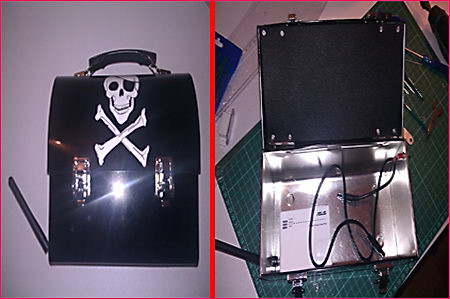
    Piratebox is a self-contained hardware device providing file sharing services to anyone who connects to the network, it includes shoutbox for communication in between users. A Piratebox is not connected to the Internet, it creates an ad-hoc wireless network acting as access point broadcasting its signal to anyone around to share files, there is no need to login, for privacy reasons activities aren’t logged. The software can run on any router supporting Openwrt and dd-wrt Linux firmware,or a laptop, there are initiatives to run Piratebox on an Android phone.

    When a Piratebox is switched on it will broadcast the wireless SSID (Service Set Identifier) “Pirate Box- Share Freely” after someone connects to the network the Internet browser is launched with a minimalistic interface allowing people to upload/download files, browse available files or chat over the network.

    Piratebox anonymous filesharing hardware
    Piratebox  file sharing hardware

    By not being connected to the Internet the number of users are reduced to Piratebox’s broadcasting range, around 30 meters, on the other hand this tool can not be taken down like a server, it is portable, easy to set up, and it only needs an Internet browser to work, there is no need to download any software, smartphones with Wi-fi can access it too.

    Tools like the Piratebox can be useful in countries where there is no Internet due to a Government cutting it off or lack of material resources, but the location of a Piratebox could be pinpointed using radio triangulation and there is no encryption making it possible to eavesdrop on users, besides the fact that someone could set up a rogue Piratebox to entrap people, the greatness of Piratebox resides on its portability and not needing an Internet connection. It is a good tool to share low level risk files and to quickly set up a filesharing network without Internet access, but not a a serious privacy tool that will protect you from state sponsored opponents.

    Visit Piratebox DIY homepage

  • Unlock and delete blocked files with LockHunter

    Unlock and delete blocked files with LockHunter

    Lockhunter can unblock and erase files or folders blocked for no reason, like malware protecting files against user deletion. LockHunter can be used through the interface or with the integrated Windows right click context menu, after selecting a file you will see a choice reading “What is blocking this file?” that will give you information on the process that is holding it up, instantly knowing if the file is in use or it is maliciously prevented from deletion.

    It is not necessary to erase a blocked file, you can choose to unlock and rename or unlock and copy it somewhere else, the program can be used from the command line, useful in case you can’t launch software due to computer problems. LockHunter can unload DLLs (Dynamic Link Library) from processes without terminating the process, a DLL is a  a Windows executable shared library with the extension .dll , .ocx , .cpl or .drv and can cause files to lock.

    Lockhunter unlocks blocked files
    Lockhunter unlocks blocked files

    In my experience specialist data wiping tools like Eraser can also get rid of blocked files or folders, but LockHunter adds many more options, it gives you information on what process is using the file or folder and it sends it to the Recycle Bin making it possible to restore it if necessary, greatly reducing the possibilities of erasing something by mistake, just because a file is locked it doesn’t mean it is malware. A portable version of Lockhunter is planned for the future.

    Visit LockHunter homepage

  • GPG Tools Windows Privacy Tray review

    GPG Tools Windows Privacy Tray review

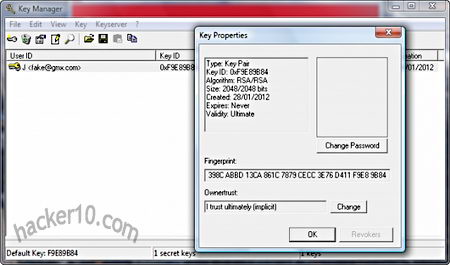
    WinPT is an open source graphical front end for GnuPG, a compatible OpenPGP software that allows people to exchange encrypted messages and files with other PGP users, without WinPT you would only be able to use GnuPG from the command line which requires a long learning curve, GnuPG is included in the download. After installing Windows Privacy Tray you will be asked to create or import your public encryption keys and associate the program with .asc, .gpg and .sig files. The default extension for encrypted messages is .gpg but this can changed to .pgp in preferences.

    All of the needed GPG/PGP functions are available, setting up your preferred keyserver, importing and exporting keys, setting ownertrust, revoking keys, digitally signing messages or files and others. Hotkeys can be used to quickly encrypt and decrypt messages.

    public key GPG encryption WinPT
    public key GPG encryption WinPT

    The software includes plugins for Euroda and Outlook Express, key management, and encryption and decryption of text in Windows clipboard. WinPT is a good alternative to GPG4Win, another free OpenPGP compatible tool, I did not notice too many differences in between them, WinPT is lighter and a smaller download, and GPG4Win has a few more features like Claws Mail and a bigger community. You will still need to learn how public key encryption works, this software is not as automated as Enigmail, a GPG Thunderbird plugin, but it can be used to encrypt files and text outside of your email client to store them online for example, so it has more functions. To protect against brute force attacks it is much safer using an encryption key and a password than just a password.

    If you are looking for a free alternative to the expensive Symantec PGP Desktop, more suitable for businesses, WinPT will get the job done, an easy and simple way to send encrypted messages or attachments by email with the power of OpenPGP.

    Visit GnuPT homepage

  • FBI software specifications to monitor social networks

    The Federal Bureau of Investigation is calling on IT companies to submit a “white paper” on how to build a software tool to monitor social networks like Facebook and Twitter, they want to use the information collected to predict and respond to crisis. The system should be able to work in real time, with search capabilities of social networks and news sites like the CNN and MSNBC, using keywords and parameters defined by FBI agents, with automated filtering of collected data. Other specifications include instant notifications of breaking events triggered by keywords and the alerts being shown colour coded on a geospatial map with the ability to save and archive warnings, they even mention their preferred maps, which are Google Maps, Google 3D Maps and Yahoo Maps.

    The application should help view domestic terrorist threats and worldwide, classifying terror groups, being able to quickly locate US embassies and Government installations around the globe including details like the weather forecast and displaying video feeds of traffic cameras in real time to spot traffic patterns like bottlenecks, obstructions and flash mobs. Twitter is specifically mentioned and the FBI asks for the ability to instantly search and monitor all publicly available tweets across the whole Twitter site, the application must be able to translate foreign language tweets into English, using a minimum of 12 different languages, attaching a reference document of “tweet” lingo for officers to be able to understand the data. Vendors able to build that kind of mass surveillance software must include their estimated pricing to the FBI.

    A quick reminder that if you don’t want your Facebook postings to be read and stored by the FBI, the only privacy workarounds are not to use a social network, use something more anonymous like Unseen.is, or to only post in private not allowing public view. Besides the Government, employers and enemies alike can find the information you post in Facebook useful too.

    Reference: Federal Business Opportunities (fbo.gov)