Hacker10

  • Bypass Internet filters retrieving websites by email

    Bypass Internet filters retrieving websites by email

    Web2PDF is a free service to convert websites to PDF and it allows you to receive full websites in your email as a PDF files.

    It is being sold as a service for those with limited access to the Internet but it also works fantastic to bypass Internet filters, as long as you can access to your email you can ask Web2PDF to send you via email any website in the World, whether blocked by your ISP in your country or not, Web2PDF servers converting sites to PDF are located in the United States and that is the location that will matter when you request a blocked site is sent to you.

    I have tested Web2PDF requesting pornographic sites are sent to my email and it works very well with the service sending me via email a PDF that includes pictures and text.

    I tried to request single pictures or single files from a website and it returns a blank PDF, the request needs to be a full page and not a single file, the PDF that Web2PDF sends you is non clickable  you can not visit the links included, other than that this works perfectly well, it took 2 minutes for my banned website to be received in my email inbox, just make sure you can receive attachments.

    There is no Internet filter capable of blocking this page retrieval system, it would be necessary to block your access to all email services for that. You can also use a mobile device able to read PDF files and capable of receiving email and browse the Internet this way, however data bills must still be taken into consideration.

    Read websites without Internet access

    If you do not have Internet access at home and normally use a Library or Internet cafe for an hour a day you can ask Web2PDF to convert to PDF all of the websites you would like to browse, save the PDF converted sites on a USB memory stick and read them with time in the comfort of your home with an E-book or any other device able to read PDF files.

    If your College or workplace limits your Internet connection to only email, you can request Web2PDF the websites be sent to your email and get around the filter restrictions. Any network administrator looking at your activities will not be able to know that you are browsing the Internet and what sites you visit, at most they could see that some of your emails contain attachments and its size but not able to read the content if you use an email service with SSL encryption protecting you from from man in the middle attacks.

    Web2PDF tutorial: Click to picture enlarge

    Web2PDF tutorial
    Web2PDF tutorial

    To receive any website in your email as a PDF document send a message to: SUBMIT @ WEB2PDFCONVERT.COM simply write the URL you want to retrieve in the subject or body of the message and leave the rest of the message blank, you should receive a copy of the requested website in your inbox in a few minutes.

    Visit Web2PDF homepage

    Read a website anonymously without leaving logs

    You can use Web2PDF if you do not have a proxy server and want to anonymously visit a site without anyone knowing and leaving no logs on the server, if you request the site is sent to you via email the only IP logged by the site you are reading will be the Web2PDF computer IP address, I have checked this on my own server and Web2PDF bot identifies itself as ISP VolumeDrive located in Clarks Summit, Pennsylvania, United States.

    VolumeDrive is a data centre, I am assuming that is where their automated bot resides, although Web2PDF itself has its headquarters in Lithuania (Europe).

    I do not know the maximum number of websites you can request to be sent to your email but there is a cheap premium option that removes that limitation, allows you choose the paper quality and it removes their company logo from the PDFs sent to your email.

    Search the Internet using your Email

    If you are not sure of the website URL address you want to retrieve, you can use a service called Web2Mail that works like Web2PDF and has extra features, it will not send you PDF files it uses HTML files instead which reduces the size of the email.

    To use Web2Mail to search the internet via email you just input the search words in the email subject, send it to their address at WWW @ WEB2MAIL.COM and you will get a reply with your internet search results in your inbox in 5 minutes.

    Web2Mail also allows you to set up Email subscriptions to your favourite web pages, you don’t need to request them all the time, you can set up Web2Mail to send you a copy of certain website daily or weekly to your email inbox.
    Visit Web2Mail homepage

  • CryptoNAS to encrypt your Network Attached Storage data

    CryptoNAS to encrypt your Network Attached Storage data

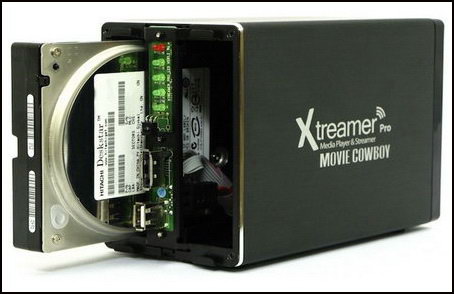
    A Network Attached Storage, commonly known as NAS, is a centralized device dedicated to data storage used to share files over a network, either your own local home network or the wider Internet.

    Network Attached Storage devices contain one or more hard drives and are networked with other appliances, NAS units are configured for file sharing between multiple computers. If they contain more than one hard disk they can be configured as a JBOD (Just a Bunch Of Disks), or in RAID to facilitate data back up and quick file access.

    Small and remote offices and home networks they all normally use a NAS appliance for file sharing, NAS drives have software that can be set to automatically back up every computer on the network and they can also be used as a servers but very few of them include data encryption capabilities.

    The NAS operating system and other software on the NAS unit provides the configuration and management of the data storage and access functionality.

    Network Attached Storage device (NAS)
    Network Attached Storage device (NAS)

    CryptoNAS Network Attached Storage encryption introduction

    CryptoNAS is a multilingual Debian based Linux live CD with a web based front end that can be installed into a hard disk or USB stick. CryptoNAS has various choices of encryption algorithms, the default is AES, it encrypts disk partitions using LUKS (Linux Unified Key setup) which means that any Linux operating system can also access them without using CryptoNAS software.

    CryptoNAS configuration and settings

    CryptoNAS provides two packages: CryptoNAS-Server and CryptoNAS-CD

    The CryptoNAS-Server: Targeted at network administrators and it adds hard disk encryption to a file server (running Samba, NFS, DAV, etc.).

    The CryptoNAS-CD: Targeted at home users and it allows for easy NAS device encryption and browsing through a web interface.

    CryptoNAS default username and password are admin:admin you should change both as soon as you have it installed. The next step is to create a configuration partition for CryptoNAS settings to be stored, after that you can enable disk encryption, format the hard disk using your file system of choice and enter the passphrase to be used, CryptoNAS will start encrypting the hard disk straight away, you will be able to see the progress clicking on status.

    CryptoNAS interface
    CryptoNAS interface

    Your router will need to be in the same subnet, which means its IP needs to be 192.168.0.1. Check the default gateway address through the network connection details, log into your router and change the address in the LAN/network settings if necessary.

    To access CryptoNAS through your web browser use https://192.168.0.23 you will get a message warning you about a problem with the security certificate since CryptoNAS uses a self-signed certificate, ignore it and go ahead.

    If you switch off the computer where CryptoNAS is running the encrypted hard drives on your NAS will shut down and it will be inaccessible until you reopen it again entering the correct passphrase. You must remember that as long as CryptoNAS is running with the disks mounted the data is unencrypted and the encryption key held on RAM memory, only if someone disconnects your NAS device (i.e. NAS device gets stolen) or you turn it off encryption will secure your data.

    Alternatives to CryptoNAS

    1. Use stand alone free open source encryption software like Diskcryptor or Truecrypt to encrypt your NAS hard drive and mount them on request.
    2. Use a NAS device that comes with encryption integrated, QNAP, Seagate, and Synology all have AES256 encryption for some of its high end Network Attached Storage products.
    3. Use FreeNAS, a free open source NAS distribution based on FreeBSD that also allows for encryption of NAS hard drives.

      Visit CryptoNAS homepage

  • How to change your browser user agent headers

    How to change your browser user agent headers

    Every time you visit a website with your Internet browser through the HTTP header exchange the server will  know what your browser brand you are using as well as your settings and what plugins you have installed, this data will be used in order to give you the optimum experience to serve you the best content for your Internet browser settings.

    Typical information that the Internet browser transmits to the server of the visited website are the operating system, the Internet browser brand, browser version, local language settings (which can be used to determine what your native language is), if JavaScript is disabled or enabled, flash or Java plug-in presence and anything else to do with the browser environment, the combination of all of these settings together with data  like geolocation, can make your browser unique and enable someone to identify and track you through websites.

    Test your Internet browser uniqueness

    According to an study by the Electronic Frontiers Foundation only one person in about 1,500 will have the same User Agent as you, once you combine this data with geolocation and unique browser plugins you can see how your Internet browser can become so unique that it can be used to track you down.

    Test how unique and traceable your browser is at: Panopticlick EFF test

    Test your Internet browser privacy and security: Browserspy.dk

    Find out your Internet browser agent headers:  User Agent String

    Internet browser logos
    Internet browser logos

    Change your Internet browser user agent

    Before you do this be aware first that changing your identifying browser user agent can make a website to display tailor made content for a different browser brand and present you with a malfunctioning page, but not in every case, this is just the price for achieving high Internet privacy. You can always disable the browser User Agent fake ID for trustworthy websites you trust and only use for places that you believe could be tracking you down on the Internet.

    The fingerprinting of your Internet browser uses a combination of your computer IP, browser header and configuration information, one of the best things you can do to confuse websites tracking you down is to use a VPN to change your geolocation combined with a random browser user agent.

  • How to stop your IP being exposed after VPN disconnection

    How to stop your IP being exposed after VPN disconnection

    Computer IP showing after VPN disconnection

    It is inevitable that either because of a shaky ISP connection or some other network or software problem your Internet connection will drop at some point and if you happen to be using a Virtual Private Network proxy to browse the Internet when your VPN disconnects, you will not get a visible warning and you will carry on browsing or sharing files peer to peer as normal with your computer IP exposed for everyone to see.

    The worst part of your VPN connection dropping out and not getting a warning is that you will not realize of this and your anonymous Internet surfing will have been compromised without you ever knowing, your OpenVPN software normally automatically reconnects after the VPN connection has dropped but by then your computer IP will have been compromised.

    How to stop a VPN disconnection showing your computer IP?

    Use an SSH tunnel for anonymous Internet surfing instead of a VPN

    One option is to use an SSH tunnel instead of a VPN, when you have your browser configured to browse the Internet through an SSH tunnel when the Internet connection goes down for whatever reason the browser stops working, as simple as that.

    The downside of using an SSH tunnel is that you will need to configure every single application to go through it but once you have done it once this is not difficult, your SSH tunnel provider should be able to provide you with instructions.

    Most anonymity providers are jumping into the VPN bandwagon and there are not many SSH tunnels providers left, some of the ones I know of are Cotse, VPNSecure, and JTAN ProShell.

    Another advantage of using an SSH tunnel for anonymous Internet browsing instead of a VPN is that it is very easy to make it work in all Unix systems, it does not matter if your main operating system is Linux, Solaris or NetBSD instead of Windows. When you use an SSH tunnel for anonymous Internet browsing you do not have to rely on the OpenVPN software given by VPN providers, which usually is closed source.

    If you use an SSH tunnel for anonymous internet surfing you will also have two IPs at the same time, your real computer IP in one browser, not configured to go through the SSH tunnel, and your anonymous SSH tunnel IP to be used with a second browser to visit sensitive sites.

    It is fairly easy to set up your own private SSH tunnel on a cheap shared Virtual Private Server if you know about Unix and are comfortable with the command line. Setting up your own private VPN server on the other hand normally requires a dedicated server which makes it much more expensive and not economically worthwhile for a single user.

    Get a VPN provider that protects your privacy from VPN disconnections

    Not all VPN providers are made equal and some of them have realised that there is a huge privacy problem when the VPN connection drops and your computer IP is exposed without warning, some VPN providers are starting to include a new feature to stop your browser from accessing the Internet unless it is through the VPN.

    There are few VPN providers I know of that provide this at the moment, one of them is Hide My Ass which has a secure IP bind which forces your specified application to only work behind their encrypted VPN. Another VPN provider that will protect you against disconnections is IdealVPN it comes with software called VPNGuardian that shuts down your Internet when the connection breaks.

    Always ask a VPN service if they have they have protection against disconnections revealing your real IP before buying their product.

    VPNCheck
    VPNCheck

    Use a software application to stop IP exposure after VPN disconnection

    VPN LifeGuard: Open source freeware application that will cease all traffic (P2P, browser,etc) in case of VPN disconnection. It can automatically reconnect the VPN and there is a portable version available, it only works with PPTP.

    VPNCheck: VPNCheck will disable your web browser or any other specified application to stop your real IP being exposed when your VPN connection breaks.

    VPNetMon: VPNetMon prevents unsecured connections after your VPN connection goes down, VPNetMon will close down the specified applications when your Virtual Private Network disconnects.

    Use a firewall to force all your applications through the VPN

    Using a software firewall you can tell it to allow applications to connect only through the VPN, including your browser, the only downside to this is that firewalls all have very different configuration settings and you will probably need to read the documentation or ask at some computing forum about how to bind your browser with your VPN connection.

    The firewall that comes with Windows has few configuration options, Comodo Firewall can be customized to your taste to stop all Internet browsing that does not follow your established rules like going through the VPN.

  • How to crack a .zip or .rar password protected file?

    How to crack a .zip or .rar password protected file?

    How secure is Winzip and Winrar encryption?

    Both programs WinZip and WinRar use AES (Advanced Encryption Standard) for encryption, when implemented correctly and in conjunction with a long alphanumerical hard to guess passphrase, the AES cipher is impossible to crack in a reasonable amount of time, that means in your lifetime.

    State sponsored agencies are also not able to crack a password protected Zip or Rar file if this has been encrypted with a hard to guess pass, the law of mathematics just like the law of physics, is equal for everyone.

    Recovering a password protected .zip or .rar file

    The only known method to recover a forgotten password from a password protected .zip or .rar file created using the latest WinZip and WinRar versions, is to use a brute force attack. In a brute force attack an automated software will use up all of the dictionary words and run all of them attempting to match the file password.

    Knowing if special characters and numbers were used in the passphrase, as well as knowing the length of the password, is very helpful while setting up the program to launch a brute force attack against the encrypted .zip or .rar file.Cracking a .zip file protected with encryption can take minutes, months or a hundred years, depending on processing power and how hard to guess the password is.

    Services to crack encrypted .zip files

    CloudCracker:  A cloud based service for cracking WPA/WPA2 keys, CloudCracker offers brute force dictionary attacks against password hashes, wireless network keys and password protected documents, you could do this yourself in your computer but this service gives you access to an online cluster speeding up the process.

    PWCrack: This password cracking service covers .zip encrypted files and PKZip files. Normally they will test a dictionary attack and brute force passwords up to 7 characters long.Password Crackers Inc. also offers services to crack many more different kind of encrypted files.

    ElComSoft distributed password recovery
    ElComSoft distributed password recovery

    Software to crack password protected .zip files

    Advanced Archive Password Recovery: This commercial software from ElComSoft helps you crack .zip and .rar encrypted files. They claim cracking archives created with WinZip 8.0 and earlier is possible in under one hour by exploiting an implementation flaw. For.zip or .rar files encrypted using the AES algorithm a brute force attack will be launched.

    Passware Kit Enterprise: This a professional solution and not targeted to end users. Password Kit Enterprise supports cracking of multiple different files, from encrypted .zip and .rar up to launching brute force attcks on fully encrypted disks using TrueCrypt. Passware Kit EnterPrice can use multiple core CPUs and nVidia GPUs to speed up the dictionary attacks.

    LastBit: This company makes a full range of password recovery software to help you bring back forgotten passwords on ICQ, Skype, Firefox, PDF, PowerPoint, Zip and many more applications. Various Lastbit products support rainbow tables which considerably speeds up dictionary attacks.

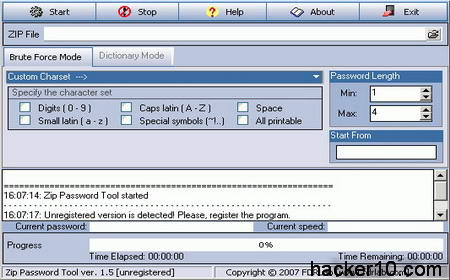
    Zip Password Tool: An easy to use password recovery tool that works launching dictionary attacks on encrypted ZIP compatible software. It supports AES file encryption cracking and you can customize the brute force attack with special characters and national symbols, there is also a password recovery progress bar.

    Zip Password Tool cracking .zip password
    Zip Password Tool cracking .zip password

    Tips to help you recover passwords from encrypted files

    The following information will be of great use when launching a brute force or dictionary attack against any kind of password protected file or disk.

    Find all the other passwords you can from the PC, notes around the computer and things someone might have saved in their web browsers and the Windows password, many people use the same or similar passwords everywhere.

    By collecting all of the user passwords you will be able to observe a password pattern, like how many characters are normally used to create a password, names of cities, pets or family members being used, capitalizing of the first letter, etc, you can then customize your cracking software and set it up to use the same password pattern that the user normally adopts.

    WinZip does not hide the encrypted filenames, you should be able to list them, unless they packed an archive inside an archive, that might give you a clue about the contents and whether it is worth to try and crack it or not. Notice that WinRar however, has an option where the user can encrypt the filenames, although this is not active by default and a checkbox needs to be ticked.

    Cracking Zip file encryption from versions earlier than WinZip9.0 is easy and there is no need for a brute force attack as there was an implementation flaw in the encryption. Since WinZip version 9 and above .zip files are protected using 128 or 256 bit AES and with a sufficiently complicated password finding it out will be impossible.

    Dictionary attacks for a long password with characters outside of 0-9 and A-Z are very slow, when you plan a dictionary attack on an encrypted .zip or .rar file, limit the yourself to alphanumeric unless you are certain a special character was used to create the password.

    Another approach is to scan the disk for all words and then try them in different upper and low case combinations against the encrypted file.

    Conclusion about security of encrypted .zip and .rar files

    The latest versions of WinZip and WinRar both use AES128 or 256 bit for encryption, this cipher is a security standard and safe from cracking as long as the password is sufficiently long and contains upper and lowercase letters, special characters and numbers.

    The weakest link in .zip and .rar encrypted passwords is you, avoid reusing your passwords anywhere else and writing them down, with the exception maybe being a password manager you trust.

    Make sure that you only encrypt .zip and .rar files with WinZip9.0 and above and Winrar3.0 and above as earlier versions have some vulnerability.

    There are many companies out there promising to crack files encrypted with WinZip and WinRar, and they all rely on the same, either you using an old version of the file compression software, or you choosing a weak and easy to guess password, as long as you cover those two vulnerabilities, you are safe using WinZip or WinRar for encryption, my first choice would be WinRar since WinZip does not support file name encryption.

  • List of privacy search engines for anonymous Internet search

    List of privacy search engines for anonymous Internet search

    Every time you use a search engine to look something up on the Internet personally identifiable information will be collected by all major search engines. The search terms submitted to the search engine, as well as the time, date, and geographical location of the computer carrying out the search will be logged and stored.

    The search words you enter are often stored within search boxes in your browser, your computer will normally cache those words and pages you visit, your searched for terms can be retrieved by anyone with access to the hard disk.

    Do you really want search engines like Google or Bing to know everything you search for on the internet?

    What information do search engines keep?

    1) IP Address: Your personal computer IP address can be traced back to you through a reverse DNS lookup with tools finding out not only your ISP but also your approximate location such as State or Province.

    2) Date & Time: The exact date and time you were searching for a certain keyword will be logged. The browser you use is normally also stored in search engines logs.

    3) Query Terms: The terms your searched for will be stored.

    4) Cookie ID: A unique code is embedded into the cookie and assigned to a particular computer by the search engine. It allows a search engine to learn if requests came from a particular computer, as long as that identifiable cookie is still stored in the browser Internet searches can be linked and traced back to you independently of what computer IP you use.

    Notice that after some pressure from privacy groups some major search engines have begun to mask the computer user IP address on their search logs but this does not make your search history anonymous.

    What information do search engines send to webmasters?

    After you click on one of the results given by the search engine, your search terms are passed to the website server logs, that webmaster will know what search terms you used to find that site, the referring URL and your IP address, as well as other data like your Internet browser and operating system you are using and even your default browser language, all of this can help to identify you.

    Google maps search
    Google maps search

    Privacy search engine Duck Duck Go

    Your web browser automatically sends information about your user agent and IP address to the search engine but Duck Duck Go will not store it at all. This information could be used to link you to your searches and other search engines will use it to show you more targeted advertising. Duck Duck Go will go out of its way to delete that data.

    At Duck Duck Go no cookies are used by default and they do not work with any affiliate program that will share personally identifiable information like name and address. Feedback at Duck Duck Go can also be given anonymous not having to enter an email address in the form (it can be left blank). This privacy search engine also allows searching via its SSL website and lots of customization options.

    Duck Duck Go pulls results from Microsoft’s Bing and Google search APIs, a lot of what you’re getting are results you could find on those search engines with the added advantage that your personal privacy is respected while searching the Internet. Duck Duck Go also has its own web crawler and web index.

    https://www.duckduckgo.com

    Duck Duck Go no logs search engine
    Duck Duck Go no logs search engine

    Privacy search engine IxQuick & Startpage

     IxQuick was awarded the first European Privacy Seal, IxQuick privacy search engine will not record your IP address, other data like the search queries are deleted from the log files within a maximum of 48 hours, often sooner.

    IxQuick uses the POST method to keep your search terms out of the logs of webmasters of sites that you reach from their results, the major search engines on the other hand, use the GET method which allows web servers to log what search terms you used to reach them.

    You can use encrypted Secure Socket Layer (SSL) connections to carry out your search stopping your ISP from snooping on you, this is of vital importance if you are using a public computer in an internet cafe, library or at work where the network administrator can easily spy on your search terms.

    IxQuick uses a single anonymous cookie to remember the search preferences you saved for your next visit, it will not use cookies with a unique ID like many other websites do.

    IxQuick also allows for advanced syntax search and being a Metasearcher, it pulls some of it results from other major search engines like Bing, Ask or the Open Directory. IxQuick also lets you visit the chosen page with a built in proxy,  the webmaster server logs will only see/log IxQuick IP address and not yours.

    I tested IxQuick search proxy on my server and it also spoofs your agent ID and operating system, identifying itself as Google Chrome and Windows 7, this is a good practice as it makes even more difficult to pin you down.

    The Dutch IP IxQuick search proxy gives once reversed identified itself as Webhosting customers, making it obvious it is not an ISP but a hosted proxy, the URL entry was presented as blank in the server logs, overall, their proxy for searching in privacy does a good job at keeping your privacy online.

    https://www.ixquick.com or https://www.startpage.com

    IxQuick privacy search engine
    IxQuick privacy search engine

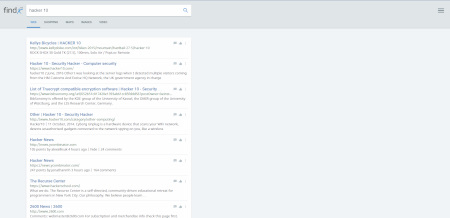
     Search engine Findx

     This search engine from Denmark can be used to find webpages, images, videos and shopping, results are crawled by its own bot and it does not rely on Google or Bing, users can contribute to improve search results by rating them.

    In Findx your search history is not saved anywhere, you are not tracked, and no identifiable information is kept, the company has a clear privacy policy easy to find. Findx claims that if required by law to share personal data they will have to comply with it, but since they do not hold anything identifiable, it is impossible for the company to provide data.

    They also plan to release an Internet browser for private browsing, called Privafox in the future.

    https://www.findx.com

    Findx privacy search engine
    Findx privacy search engine

     Usenet search engine BinSearch

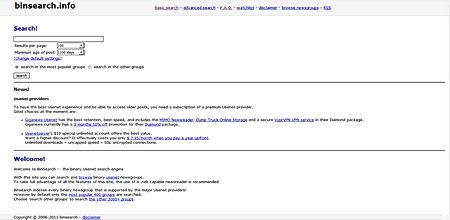
     This is not an anonymous Internet searcher but it is included on the list because it carries results that nobody else does. BinSearch specialises in crawling binary Usenet newsgroups results that are ignored by all major search engines. You can search for Usenet posts subject, filenames or .nfo and limit your search to certain newsgroup or timeframe.

    Due to the huge amount of data that Usenet carries, results are refreshed every few weeks and old ones dropped, Binsearch crawls thousands of groups but it is not possible to index all of them, only the major newsgroups.

    http://www.binsearch.info

    BinSearch binaries Unsenet search engine
    BinSearch binaries Unsenet search engine

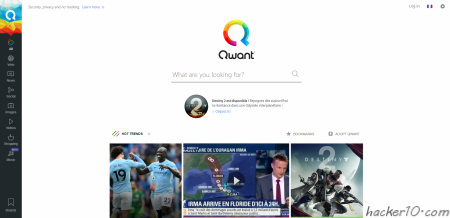
    Privacy search engine Qwant

    A search engine based in France that promises not to collect your data, they do not even put a cookie in your browser, if you want your settings to be remembered you have the option of opening an account with Qwant anonymously, otherwise the search engine does not remember anything. They have a data protection staff member and their privacy policy is very well explained and clear.

    Search results come from its own crawling bot complemented with Bing, you might see advertising but it is not targeted since Qwant does not track its users. You can use this search engine to find webpages, images, videos, news, shopping, music and social. There are two versions of Qwant you can access, one of them where the search engine displays results from across multiple sources, including social media, and one light URL that only displays results for webpages without pictures, this saves bandwidth.

    https://www.qwant.com

    Qwant privacy search engine
    Qwant privacy search engine

     Tips to search the Internet with privacy

    Do not accept any of the major search engines cookies, they might use them to identify you later on, if you already have a Google or Bing search engine cookie on your computer, delete them.

    Do not sign up for email at the same search engine where you regularly search, your personal email address can potentially be tied up to your search terms. Using Google and Gmail (both Google products) or Bing and Hotmail (both Microsoft products) together is not a good idea.

    Mix up a variety of search engines, this will spread all of your searched terms across different companies and servers. Varying the physical location you search from can also be helpful, you can use a VPN to change your computer and country IP and delete all of your search engine cookies before starting a new private searching session.